 Ethliquity
 concerns how Liquity V2 owners delegate Trove management
Ethliquity is a query about delegating Liquity V2 Trove management through separate permissions for interest rates and balance changes. Owners can appoint individual rate delegates, join managed rate batches, or authorize collateral and debt adjustments. Each permission controls a different part of the position.
last updated
The short version: A Liquity V2 rate delegate can increase borrowing costs through permitted rate changes without receiving authority to withdraw collateral.
Delegation belongs to a Trove within a collateral branch
A Trove records collateral and BOLD debt, while its delegation settings determine which addresses can manage particular operations on that position. Liquity V2 separates individual rate delegation, batch rate management, and Add or Remove Manager permissions. Granting rate-management authority does not appoint an Add or Remove Manager.
These settings belong to the relevant collateral branch and deployment on Ethereum mainnet. The initial V2 deployment became legacy after its Stability Pool issue. Liquity announced the replacement deployment live on May 19, 2025. Manager addresses and permissions from the legacy contracts do not carry over automatically.
Individual rate delegates use boundaries the owner sets
An individual interest delegate can adjust one Trove's annual borrowing rate within owner-selected bounds, subject to a minimum interval the owner also specifies.
The authorization identifies the delegate address, lower and upper rates, and update interval. A requested rate outside those bounds fails the delegate-specific checks. A request arriving before the permitted interval expires also fails, even if the proposed rate falls inside the range.
A separate wallet can perform delegated updates manually. An automated contract can implement a rate strategy. In either case, the protocol checks the authority and submitted parameters; appointing a delegate does not itself supply an automated strategy.
The owner retains control over the appointment and can revoke it. Revocation removes permission for future delegated updates. It leaves the existing rate and outstanding debt in place.
Batch managers apply a shared rate without merging ownership
A registered batch manager sets one annual borrowing rate for its member Troves, within the range the manager chose at registration. That registered range cannot subsequently change. Joining a batch adopts its current rate, so the borrower accepts the manager's future choices throughout that range. The manager also commits to a minimum update interval and selects an annual management fee. The protocol updates the batch's rate collectively, avoiding a separate rate adjustment for every member. Collateral remains recorded per Trove, and individual positions can have different collateral ratios.
Individual rate delegation and batch membership cannot coexist on the same Trove. Add and Remove Manager permissions remain separate from either rate-management arrangement.
Balance managers receive different permissions over collateral and debt
Add and Remove Managers authorize balance operations, with broader consequences than a permission confined to rate setting. The owner can configure these roles separately.
Adding collateral and repaying BOLD
An Add Manager can contribute collateral or repay debt. These actions increase collateral backing or reduce the obligation. If the Add Manager setting is the zero address, any address may perform those contributions, subject to normal operation requirements. Setting the owner as Add Manager restricts this access to the owner and any separately appointed Remove Manager.
Clearing an Add Manager setting therefore opens contribution access. It does not disable contributions from other addresses.
Withdrawing collateral and drawing BOLD
Authority to change balances
A Remove Manager can withdraw collateral or draw additional BOLD debt, and also inherits Add Manager permissions. The role requires explicit appointment; a Trove has no Remove Manager by default. These powers still face collateralization and other protocol constraints.
Recipients of withdrawn funds
The owner can configure a receiver distinct from the manager. For a call from the designated Remove Manager, a nonzero receiver receives the drawn funds; a zero receiver falls back to the owner. Other owner-initiated calls return drawn funds to the owner.
V2 parameters separate update permission from adjustment fees
Liquity V2 uses different timing rules for permission to update a rate and the fee an early change incurs. Its batch parameters also constrain collateral backing and management charges.
| V2 parameter | Value | Application | Control over the setting |
|---|---|---|---|
| Rate-adjustment fee window | 7 days | Earlier rate changes can incur a premature adjustment fee | The protocol sets the fee window |
| Batch update interval floor | 1 hour | Minimum interval a batch manager may register | The manager can commit to a longer interval |
| Annual batch management fee ceiling | 10% of recorded debt per year | Maximum permitted annual management fee, separate from borrowing interest | The manager chooses the initial fee and can subsequently lower it |
| Extra batch collateral buffer | 10 percentage points above the branch minimum collateral ratio | Opening into a batch, joining, or adjusting collateral or debt inside it | The protocol enforces the collateral floor |
| Individual delegates follow an owner-selected update interval; the batch registration floor does not define their schedule. | |||
A permitted update can therefore carry an adjustment fee. The management fee ceiling is a protocol maximum, not a quoted rate for every batch.
Delegated costs enter the debt through distinct mechanisms
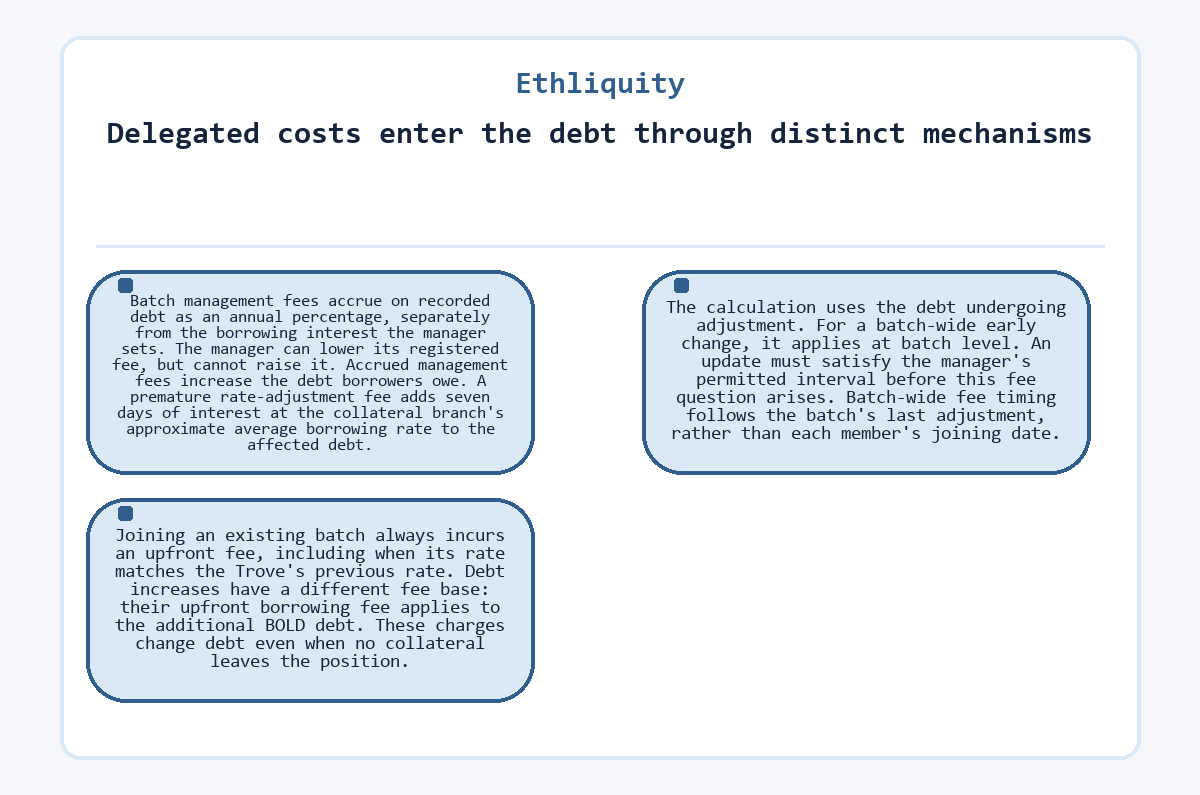
Batch management fees accrue on recorded debt as an annual percentage, separately from the borrowing interest the manager sets. The manager can lower its registered fee, but cannot raise it. Accrued management fees increase the debt borrowers owe.
A premature rate-adjustment fee adds seven days of interest at the collateral branch's approximate average borrowing rate to the affected debt. The calculation uses the debt undergoing adjustment. For a batch-wide early change, it applies at batch level. An update must satisfy the manager's permitted interval before this fee question arises. Batch-wide fee timing follows the batch's last adjustment, rather than each member's joining date.
Joining an existing batch always incurs an upfront fee, including when its rate matches the Trove's previous rate. Debt increases have a different fee base: their upfront borrowing fee applies to the additional BOLD debt. These charges change debt even when no collateral leaves the position.
Batch exits preserve accrued debt and change rate authority
The owner can remove an active Trove from its batch and choose a standalone rate, subject to applicable operation requirements. Preserving the existing batch rate avoids a premature rate-adjustment fee on exit. Choosing a different rate incurs that fee if the applicable seven-day window has not expired.
For a batched Trove, the effective last-adjustment timestamp uses the later of its own timestamp and the batch's timestamp. A recent batch update can therefore affect the fee on an exit with a rate change. Leaving also accounts for management fees and interest already accrued.
Appointing an individual delegate to a batched Trove includes removal from the batch. The replacement arrangement requires a standalone rate and remains subject to exit requirements. The
switchBatchManager
operation combines leaving and joining; entry into the replacement batch still incurs an upfront fee.
Rate decisions alter redemption exposure without moving collateral directly
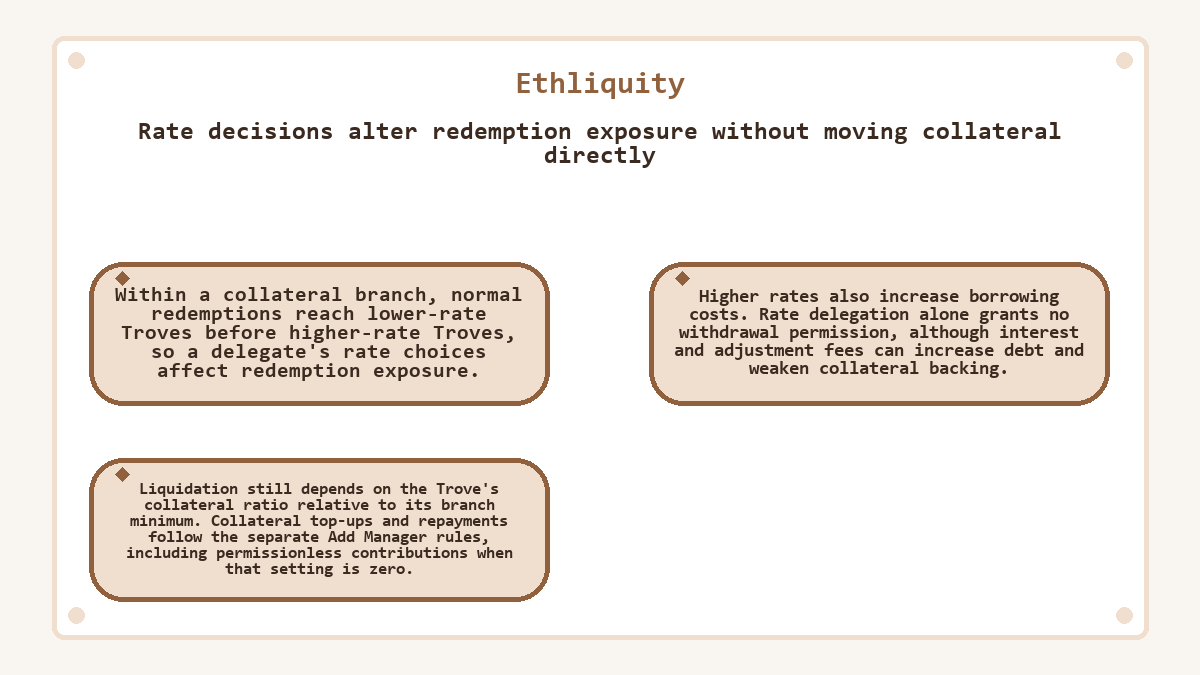
Within a collateral branch, normal redemptions reach lower-rate Troves before higher-rate Troves, so a delegate's rate choices affect redemption exposure. Higher rates also increase borrowing costs. Rate delegation alone grants no withdrawal permission, although interest and adjustment fees can increase debt and weaken collateral backing. Liquidation still depends on the Trove's collateral ratio relative to its branch minimum. Collateral top-ups and repayments follow the separate Add Manager rules, including permissionless contributions when that setting is zero.
Protocol state can block an otherwise authorized operation
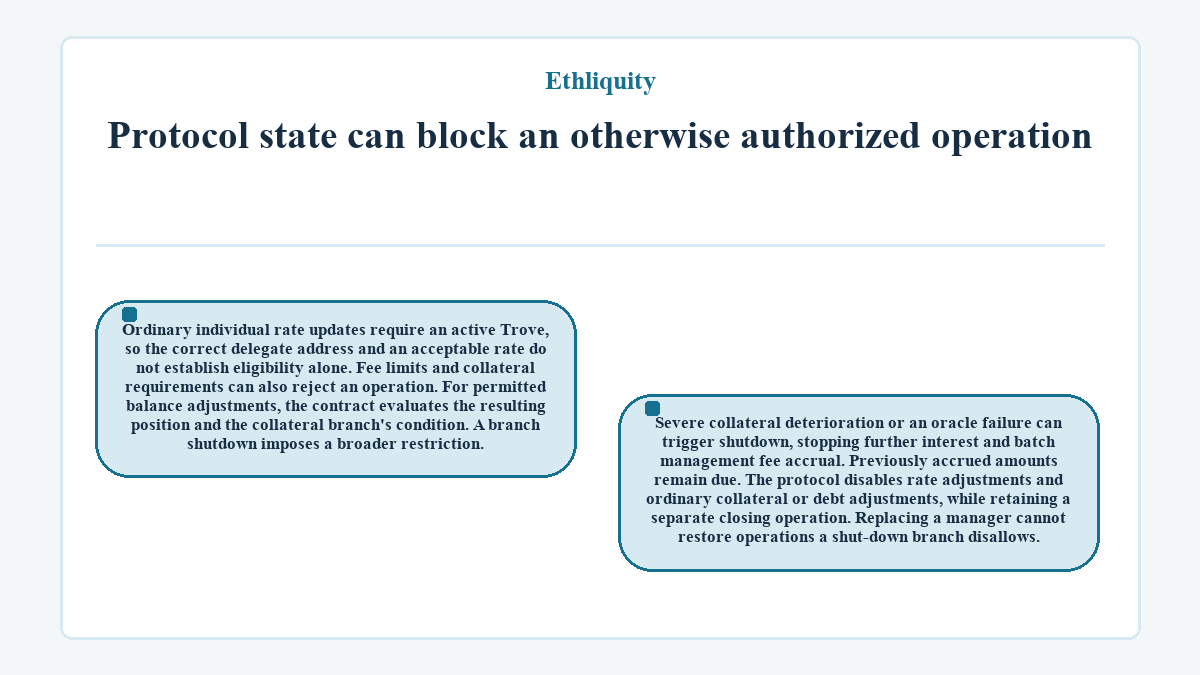
Ordinary individual rate updates require an active Trove, so the correct delegate address and an acceptable rate do not establish eligibility alone. Fee limits and collateral requirements can also reject an operation. For permitted balance adjustments, the contract evaluates the resulting position and the collateral branch's condition.
A branch shutdown imposes a broader restriction. Severe collateral deterioration or an oracle failure can trigger shutdown, stopping further interest and batch management fee accrual. Previously accrued amounts remain due. The protocol disables rate adjustments and ordinary collateral or debt adjustments, while retaining a separate closing operation. Replacing a manager cannot restore operations a shut-down branch disallows.
Frequently asked questions about Ethliquity
-
Can I nominate another wallet I own as an individual rate delegate?
- Yes, a Liquity V2 Trove owner can authorize another wallet to adjust the position's interest rate. This supports keeping ownership in one wallet while handling rate updates through another. The delegated wallet follows the owner-selected rate bounds and update interval, without receiving a transfer of Trove ownership.
-
Does appointing an individual delegate immediately change my borrowing rate?
- For an active Trove outside a batch, appointing an individual delegate does not itself change the existing rate. The delegate receives permission to submit later updates. If the Trove is already in a batch, the appointment also removes it from that batch and requires a standalone rate, with applicable exit-fee conditions.
-
Who can close a Trove after a Remove Manager is appointed?
- The owner or the appointed Remove Manager can call the closing operation. The caller must supply enough BOLD to repay the entire debt, including any accrued interest, management fees, and redistributed debt. Closing requirements still apply, including branch collateralization constraints outside shutdown. An Add Manager alone does not receive closing authority.
-
Are management fees included in the rate used to order redemptions?
- Normal redemption ordering uses the Trove's annual borrowing interest rate, excluding the separate annual batch management fee. A batch can therefore have a higher total ongoing borrowing cost without obtaining the redemption position a higher borrowing interest rate would provide.
-
Where can I read the delegate and receiver settings for my Trove?
- The relevant branch's BorrowerOperations contract exposes getInterestIndividualDelegateOf and interestBatchManagerOf for rate-management assignments. Its addManagerOf and removeManagerReceiverOf getters expose balance permissions and the configured receiver. These settings concern a specific Trove in that deployment, so an address shown for another branch does not establish the same authorization.
-
Will an individual delegate's update succeed if the proposed rate is unchanged?
- An individual rate-update request using the existing annual rate fails the contract's requirement for a new rate. Authorization and compliance with the permitted rate range do not override this check. This describes an individual Trove rate update; batch operations have their own validation rules.
-
Do individual rate delegates have permission to appoint their own replacements?
- The individual rate-delegate appointment belongs to the Trove owner, so rate-setting authority alone does not let a delegate appoint its replacement. The owner can change or remove that assignment. A delegate also cannot use this permission to grant Add or Remove Manager authority over collateral and debt.