 Ethliquity
 risks differ between Liquity loans and Stability Pool deposits
Ethliquity risks, a search query about Liquity, covers liquidation exposure, redemptions, and reductions in BOLD Stability Pool deposits. Borrowers risk collateral when prices fall or debt grows. Depositors exchange part of their BOLD balance for liquidation collateral, which carries its own market exposure. Holding BOLD also involves peg risk across the system. V1 and V2 use different rules, and the initial V2 deployment requires separate treatment from the relaunched contracts.
last updated
Bottom line: A Liquity V2 Stability Pool can reduce deposited BOLD while increasing exposure to liquidation collateral, even when its contracts operate as designed.
Deployment history determines which V2 warning applies
A warning about the initial V2 contracts concerns a different deployment from the relaunched protocol. Liquity confirmed a Stability Pool issue on February 13, 2025, and urged affected depositors to close their positions. At that time, the team reported no known affected users and described Borrow, Multiply, and Stake as unaffected. On February 18, 2025, Liquity also advised borrowers in the initial deployment to close loans while BOLD liquidity remained favorable and BOLD holders without loans to sell their BOLD.
Liquity announced the relaunched V2 deployment live on Ethereum mainnet on May 19, 2025. Redeployment introduced new contracts, so the deployment holding a position matters when interpreting older alerts. A matching token label or familiar frontend does not establish that an existing position moved.
Collateral ratios turn price and debt changes into liquidation exposure
When collateral value falls relative to total debt, a Liquity loan moves closer to its applicable liquidation boundary. The loan position, called a Trove, records both amounts. The collateral ratio expresses oracle-valued collateral as a percentage of debt at its dollar face value.
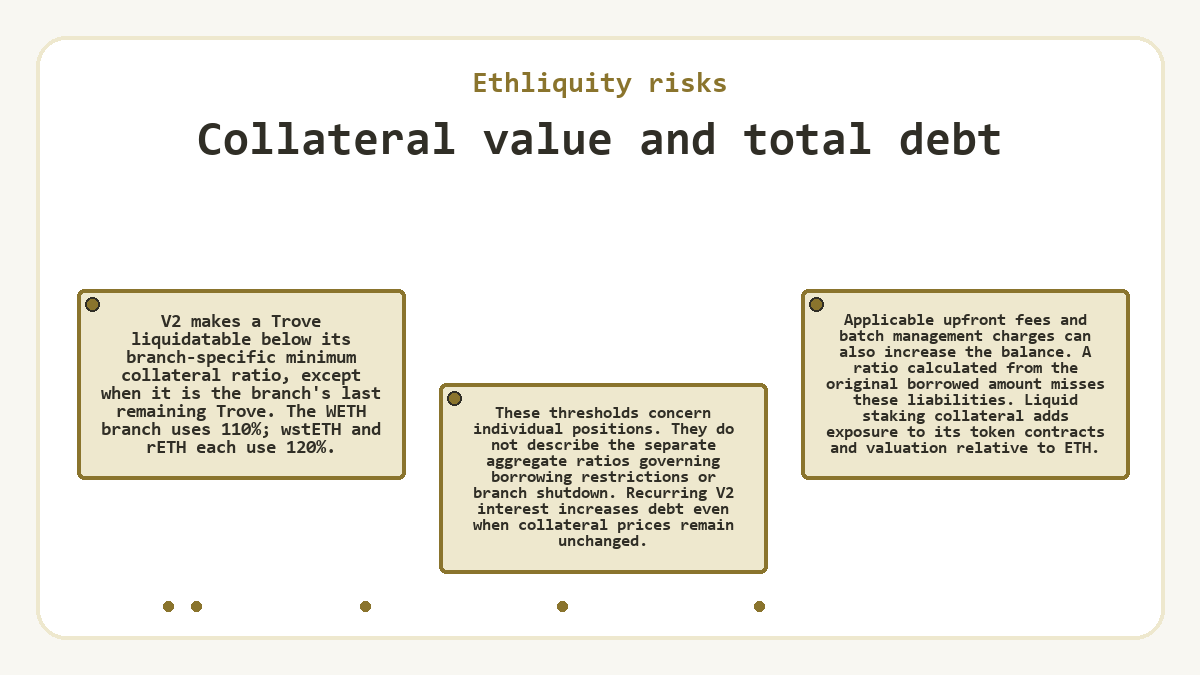
Collateral value and total debt
V2 makes a Trove liquidatable below its branch-specific minimum collateral ratio, except when it is the branch's last remaining Trove. The WETH branch uses 110%; wstETH and rETH each use 120%. These thresholds concern individual positions. They do not describe the separate aggregate ratios governing borrowing restrictions or branch shutdown.
Recurring V2 interest increases debt even when collateral prices remain unchanged. Applicable upfront fees and batch management charges can also increase the balance. A ratio calculated from the original borrowed amount misses these liabilities. Liquid staking collateral adds exposure to its token contracts and valuation relative to ETH.
System stress in V1 and V2
V1 charges no recurring borrowing interest, although borrowing normally incurs a one-time fee. Its 110% minimum applies during normal operation. Recovery Mode begins below 150% system collateralization and changes liquidation eligibility. A borrower cannot treat the normal-operation threshold as protection across every system state.
V2 removes V1's Recovery Mode and keeps individual liquidation eligibility tied to the branch minimum. Safety Mode instead restricts operations that weaken branch collateralization. If its Stability Pool cannot cover a liquidation fully, the remaining debt and collateral pass to other active Troves within that branch.
Rate choices trade borrowing cost against redemption exposure
Within an active V2 branch, normal redemptions generally reach lower-rate Troves before higher-rate positions. A larger collateral buffer does not move a borrower farther back in that ordering. Raising the borrowing rate can place more lower-rate debt ahead of a Trove, while increasing its continuing interest expense.
Redemption reduces a borrower's debt and collateral together, changing the exposure the loan preserves. It differs from liquidation: a well-collateralized Trove can face redemption. The protocol exchanges BOLD against collateral at its dollar face value, subject to redemption fees. Market prices can make redemption attractive without any individual borrower crossing a liquidation threshold.
Debt ahead of a Trove estimates exposure from loan balances that can change. Other borrowers can change rates, repay, or draw debt. Debt at the same interest rate does not provide dependable protection. A rate change within the seven-day adjustment cooldown can add another upfront fee to the loan.
Stability pools replace some BOLD with liquidation collateral
When a V2 Stability Pool offsets a liquidation, depositors acquire collateral while their deposited BOLD decreases proportionally. The chosen branch determines the collateral they receive. Selecting a pool therefore selects direct liquidation exposure to WETH, wstETH, or rETH.
Deposit reductions and collateral gains
During a V2 Stability Pool offset, the protocol burns deposited BOLD to cancel an equal amount of liquidated debt. A lower BOLD deposit can therefore reflect the liquidation mechanism operating as designed. Interest income and collateral gains occupy separate parts of the depositor's return; the original stablecoin balance does not remain intact throughout liquidations.
Losses during a falling collateral market
The collateral received can decline after liquidation, reducing or reversing any initial value advantage over the BOLD consumed. A liquidation gain expressed in token units does not guarantee a dollar profit. Repeated liquidations can leave more of a depositor's value exposed to the branch collateral during a falling market. V1 has the same broad exchange of deposited LUSD for liquidation ETH, although its pool rules and reward arrangements differ. V2's branch separation limits direct liquidation sharing between pools; it does not isolate every risk affecting BOLD.
BOLD holders share peg risk across collateral branches
Even without a loan or pool deposit, a BOLD holder depends on the collateralized system supporting its dollar target. Redemption supports that target through exchanges for protocol collateral, less applicable fees. It does not ensure every market trade executes at exactly one dollar. Choosing the WETH Stability Pool avoids direct liquidation proceeds in wstETH or rETH, while the deposited BOLD still shares system-wide peg exposure. A severe collateral failure can leave bad debt, weakening redeemability and affecting holders beyond the failed branch.
Multiply and managed rates add distinct costs
Using BOLD debt to acquire more collateral magnifies exposure to the collateral's price movements. Multiply follows this leveraged structure, so a decline causes a larger percentage loss of net value than an unleveraged holding. Borrowing charges and swap costs also affect the outcome. Available liquidity affects swap price impact, and insufficient liquidity can prevent an exposure adjustment.
Delegated rate management introduces another source of debt growth through interest choices, applicable adjustment fees, and batch management charges. A manager can operate within its permitted range and still produce costs the borrower finds unsuitable. Repeated early adjustments can erode a thin collateral buffer. Rate-management permission remains separate from authority to withdraw collateral or draw new debt, which requires the relevant additional permissions.
Oracle failure can permanently shut down a collateral branch
A V2 branch can enter shutdown after sufficiently weak aggregate collateralization or a qualifying oracle failure. The trigger concerns the branch, so an individually healthy Trove can still lose access to ordinary adjustments. Failed calls, invalid prices, or excessive staleness can trigger the oracle-failure path during an operation requiring collateral pricing.
A V2 branch shutdown permanently stops further interest accrual on that branch. The protocol still accounts for interest accumulated before shutdown. It disables ordinary debt and collateral adjustments while allowing loan closure, liquidations, Stability Pool deposits and withdrawals, and special shutdown redemptions. Those redemptions use different targeting rules from normal rate-ordered redemptions. Adding collateral or making an ordinary partial repayment is therefore unavailable as a repair within the shut-down branch. Closure requires settling the remaining debt. Shutdown helps unwind exposure; it cannot recreate collateral value lost during a collapse.
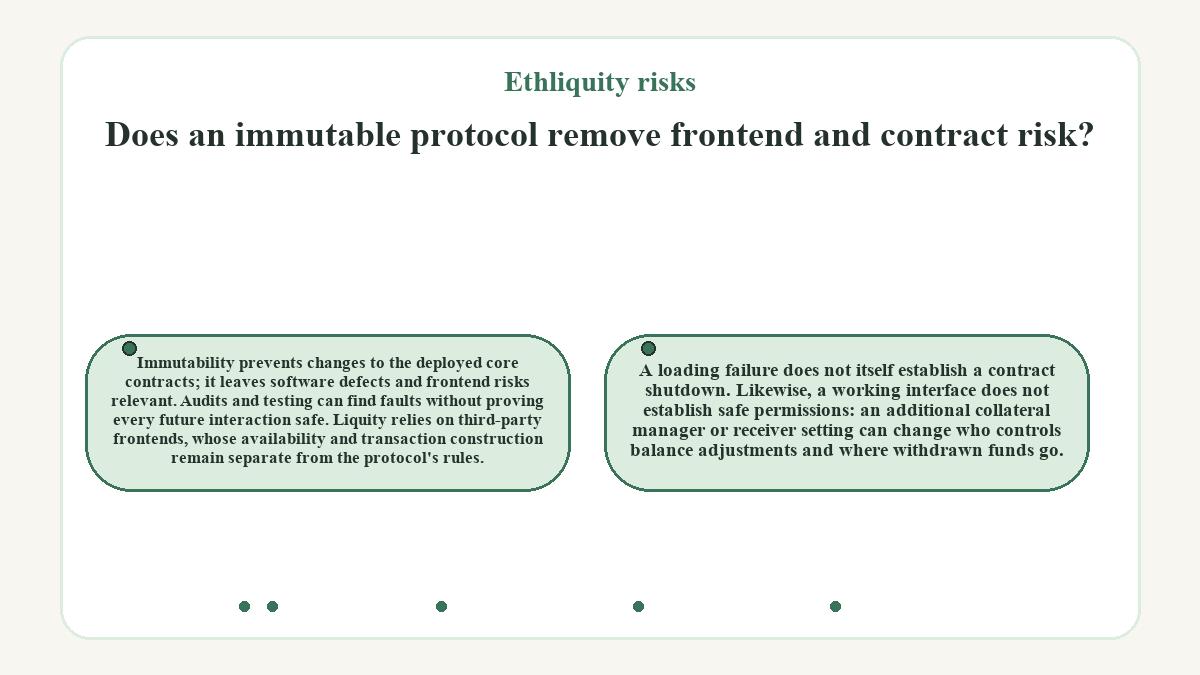
Does an immutable protocol remove frontend and contract risk?
Immutability prevents changes to the deployed core contracts; it leaves software defects and frontend risks relevant. Audits and testing can find faults without proving every future interaction safe. Liquity relies on third-party frontends, whose availability and transaction construction remain separate from the protocol's rules. A loading failure does not itself establish a contract shutdown. Likewise, a working interface does not establish safe permissions: an additional collateral manager or receiver setting can change who controls balance adjustments and where withdrawn funds go.
A Stability Pool exit depends on the remaining deposit
An exit from a relaunched V2 Stability Pool uses the remaining BOLD deposit and must preserve the pool-wide minimum. A withdrawal can return the remaining deposit fully when other deposits provide enough room above that floor.
- Identify the relaunched V2 contracts on Ethereum mainnet and the collateral branch holding the deposit.
- Read the current BOLD deposit and the pool's total deposits before choosing a withdrawal amount.
- For a full exit with accrued BOLD yield, choose to claim gains; otherwise the protocol reinvests that yield.
- Request the intended withdrawal when the resulting pool balance will retain at least 1 BOLD.
- A withdrawal that would leave less than 1 BOLD in the pool reverts. Reduce the amount enough to preserve the reserve. Another deposit can also create withdrawal room.
- After execution, compare the updated deposit record with the wallet's BOLD balance. Check collateral gains separately, including any unclaimed balance.
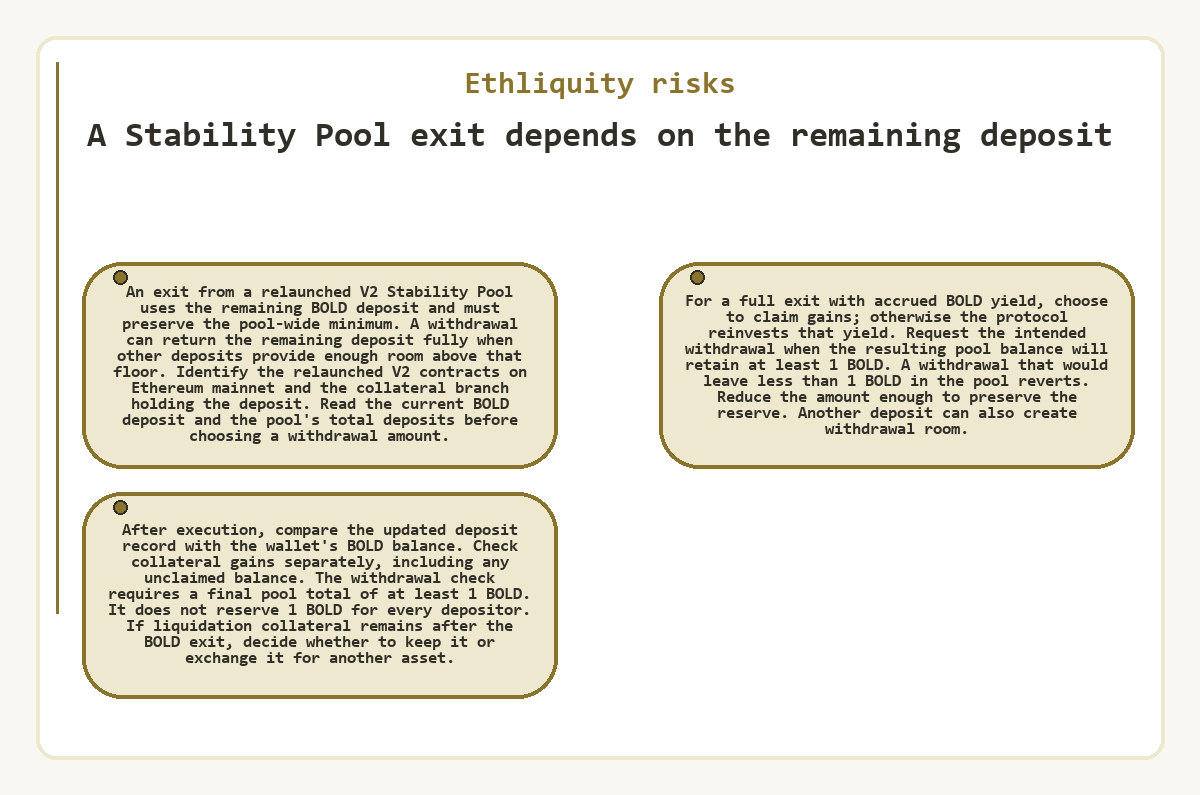
The withdrawal check requires a final pool total of at least 1 BOLD. It does not reserve 1 BOLD for every depositor. If liquidation collateral remains after the BOLD exit, decide whether to keep it or exchange it for another asset.
Everyday questions about Ethliquity risks
-
Does a BOLD redemption fee reduce the collateral left in the affected V2 loan?
- The redemption fee remains in the affected V2 Trove as collateral, reducing the amount the redeemer receives. At the protocol's collateral price, the borrower therefore loses collateral worth less than the dollar face value of the debt canceled. This fee treatment differs from V1, where redemption fees go to LQTY stakers. It does not prevent redemption from reducing exposure to the collateral asset.
-
Can a V2 Trove with less than 2000 BOLD debt still face liquidation?
- A V2 Trove with positive debt below 2000 BOLD can still face liquidation if its collateral ratio falls below its branch minimum and another Trove remains on that branch. A redemption can leave a Trove in this small-debt state without closing it. Remaining debt continues accruing interest on an active branch, so a dormant or zombie status does not remove the loan's obligations.
-
When does Liquity V2 prevent the final Trove on an active branch from closing?
- Liquity V2 blocks normal closure when only one Trove remains on an active branch. That final position preserves a recipient for redistributed debt and collateral. Other closures must leave the active branch at or above its critical collateral ratio. After branch shutdown, the last Trove can close because the protocol prioritizes winding down that branch.
-
Are V2 Stability Pool returns a fixed percentage of the deposit?
- V2 Stability Pool returns vary with branch interest revenue, the depositor's share, and liquidation outcomes. The 75% allocation concerns the share of branch interest revenue directed to the Stability Pool; it is not a promised annual return on each deposit. Changes in pool deposits alter each depositor's share, while received collateral creates separate market exposure.
-
What happens to surplus collateral after a V2 loan liquidation?
- Any claimable collateral surplus from a V2 liquidation remains available to the borrower through a separate collateral-surplus claim. Its existence and size depend on the branch, the liquidation route, and the collateral available. The protocol uses different penalties for Stability Pool offsets and redistribution, so an expected remainder should not be treated as a fixed recovery amount.