 Ethliquity
 concerns Liquity borrowing and stablecoin yields on Ethereum
Ethliquity is a query about Liquity, whose Ethereum protocols issue stablecoins against ETH and, in V2, liquid staking collateral. V1 issues LUSD without recurring interest; V2 issues BOLD with borrower-selected interest rates. Stability Pools connect those loans to liquidation funding and depositor returns. V2 also supports leveraged exposure through Multiply, while LQTY staking links V1 fee income with V2 liquidity incentives. Borrowing, holding a stablecoin, and depositing into a pool create different obligations and risks.
last updated
On this page
Key takeaway: Liquity V2 interest rates affect borrowing costs and redemption priority, while separate Stability Pools distribute interest income and liquidation collateral.
ETH collateral supports different borrowing terms in V1 and V2
V1 accepts ETH to mint LUSD; V2 accepts ETH, wstETH, and rETH to mint BOLD in separate collateral markets.
LUSD borrowing in V1
A Trove is a collateralized loan position recording ETH collateral and LUSD debt in V1. Borrowers pay no ongoing interest, although drawing LUSD normally adds a one-time borrowing fee. V1's minimum collateral ratio during normal operation is 110%. That ratio compares collateral value with debt, including applicable fees and the liquidation reserve. Recovery Mode changes borrowing restrictions and liquidation eligibility when the system's overall collateralization weakens.
BOLD borrowing in V2
V2 borrowers select an interest rate and use a separate Trove for each collateral position. The ETH branch holds WETH, the wrapped token form of ETH. wstETH and rETH represent staked ETH from Lido and Rocket Pool, respectively. The V2 ETH liquidation boundary is approximately 90.91% loan-to-value (LTV). The boundary for wstETH and rETH is approximately 83.33%. LTV divides the BOLD debt's dollar value by collateral value. Branch health and delegated batch requirements can impose stricter limits on opening or adjusting positions.
A hypothetical LTV comparison
In this hypothetical comparison, total debt is 8803 BOLD and collateral value is $10,253. Using the protocol's $1 valuation per BOLD, the calculation is
8803 / 10253 * 100
, giving approximately 85.86% LTV.
On active V2 collateral branches, that ratio puts an ETH Trove below its liquidation boundary. A wstETH or rETH Trove with the same collateral value and debt would be eligible for liquidation. It does not establish eligibility to open a new loan. The comparison holds only at the stated valuation and debt; falling collateral prices or accruing interest increase LTV.
How do V2 interest rates affect redemptions?
Lower V2 interest rates reduce ongoing borrowing costs while moving a Trove closer to the front of its collateral branch's redemption order. Standard redemptions start with the lowest-rate eligible Troves. A redemption exchanges BOLD at its $1 face value for protocol collateral, less a fee. Affected borrowers lose collateral and have equivalent debt repaid; the fee remains in their Troves. This mechanism supports BOLD's peg. Liquidation instead follows insufficient collateralization, so a healthy collateral ratio alone does not prevent redemption.
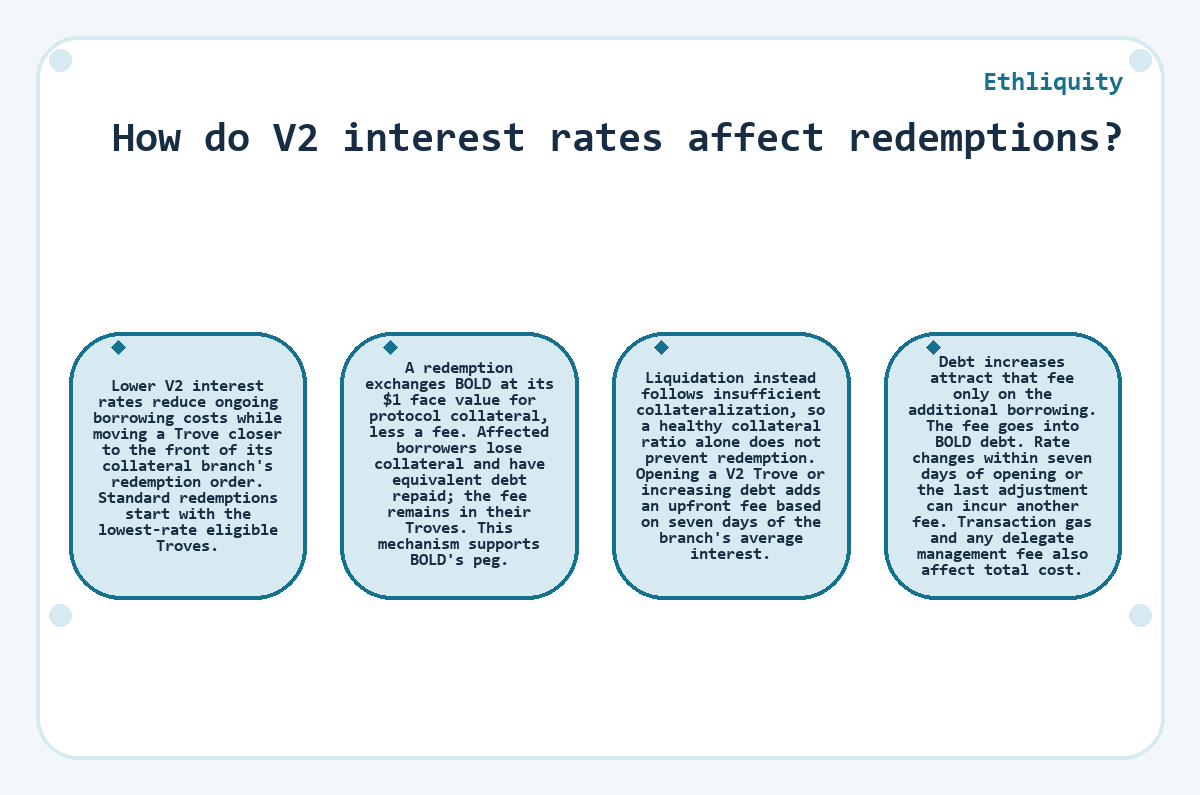
Opening a V2 Trove or increasing debt adds an upfront fee based on seven days of the branch's average interest. Debt increases attract that fee only on the additional borrowing. The fee goes into BOLD debt. Rate changes within seven days of opening or the last adjustment can incur another fee. Transaction gas and any delegate management fee also affect total cost.
Multiply increases collateral exposure with BOLD debt
Multiply borrows BOLD and exchanges it for more of the same collateral, increasing exposure to ETH or liquid staking tokens. Frontends supporting this operation can combine borrowing, swapping, and adding collateral in one transaction. Loan mode sends minted BOLD to the wallet. Both modes manage a collateralized position with BOLD debt.
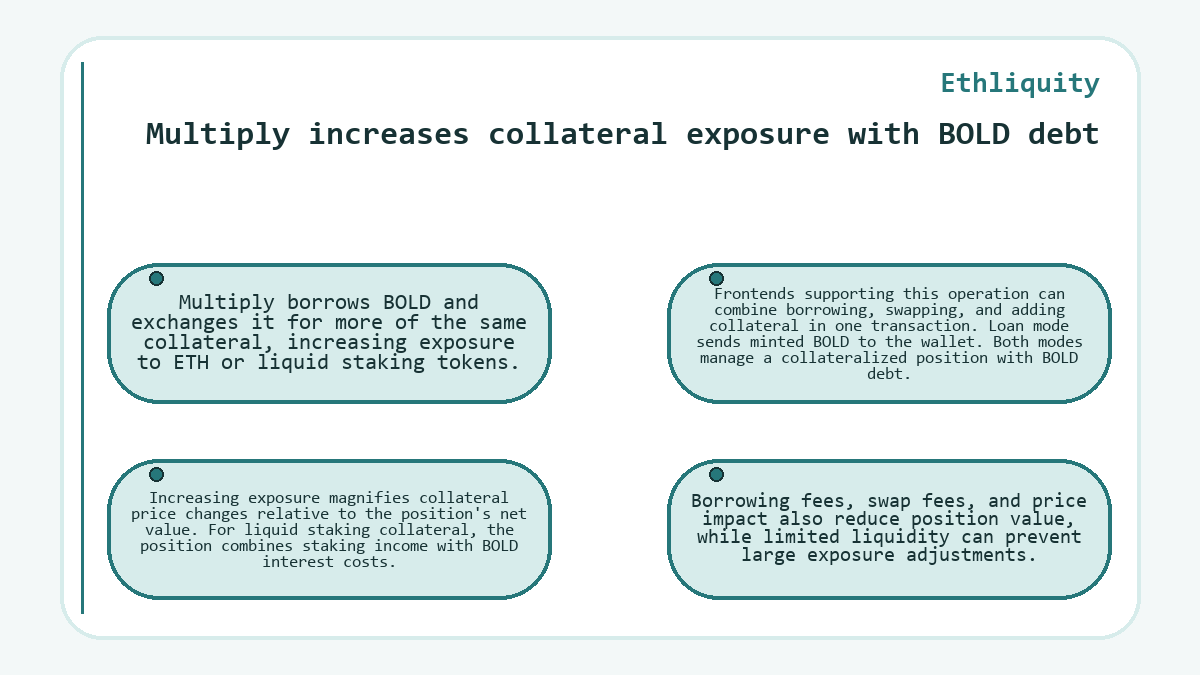
Increasing exposure magnifies collateral price changes relative to the position's net value. For liquid staking collateral, the position combines staking income with BOLD interest costs. Borrowing fees, swap fees, and price impact also reduce position value, while limited liquidity can prevent large exposure adjustments.
Stability Pools share interest income and absorb liquidations
V2 directs 75% of each branch's borrowing interest revenue to that branch's Stability Pool. Depositors receive this income in BOLD. Borrower rates, outstanding debt, and total pool deposits determine how much interest income each deposited BOLD can earn.
Liquidations also use pool BOLD to cancel debt and allocate seized collateral proportionally to depositors. That process reduces BOLD deposits while adding exposure to the pool's collateral asset. The ETH, wstETH, and rETH pools therefore produce different collateral holdings after liquidations.
Selecting one pool determines the liquidation collateral a depositor receives. All BOLD holders, including pool depositors, remain exposed to the stablecoin's combined collateral backing and peg.
V1's pool uses LUSD to absorb liquidated ETH-backed debt and distribute ETH gains. Depositing stablecoins into either version's pool differs from simply holding them. External liquidity provision and third-party vaults introduce additional contracts and their own conditions, even when their returns ultimately rely on Liquity.
LQTY links V1 fees with V2 liquidity incentives
LQTY staking in V2 combines access to V1 fee revenue with voting power over V2's protocol-incentivized liquidity allocations.
Fee income from V1
V1 stakers share borrowing fees in LUSD and redemption fees in ETH in proportion to their stake when fees occur. V2's LQTY staking arrangement retains access to this V1 revenue. Payment amounts depend on fee activity and the stake sharing it; staking does not create a fixed annual yield.
Incentives for BOLD liquidity
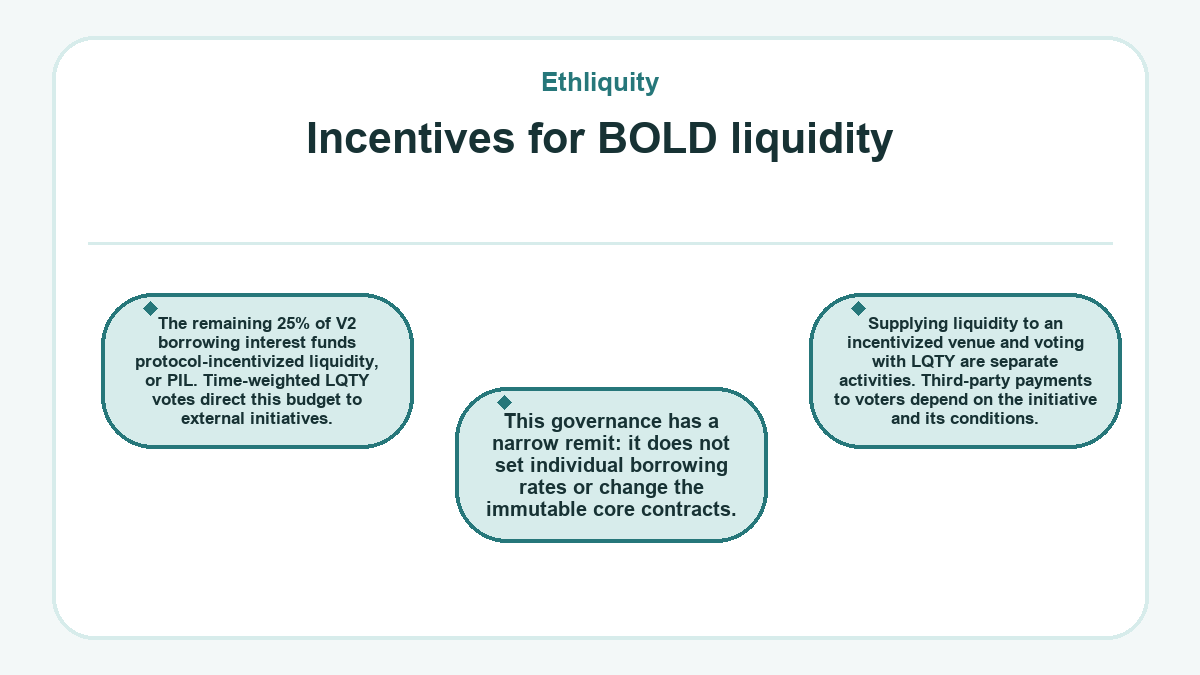
The remaining 25% of V2 borrowing interest funds protocol-incentivized liquidity, or PIL. Time-weighted LQTY votes direct this budget to external initiatives. This governance has a narrow remit: it does not set individual borrowing rates or change the immutable core contracts. Supplying liquidity to an incentivized venue and voting with LQTY are separate activities. Third-party payments to voters depend on the initiative and its conditions.
Frontend choice starts with the correct deployment
Liquity uses third-party frontends, which can differ in supported functions and rate-management services. Their operators provide the interface; Ethereum contracts maintain the positions. In the May 19, 2025 entry of V2 Redeployment Updates, Liquity announced its V2 Ethereum mainnet relaunch. The February 2025 Stability Pool warnings concerned the initial V2 deployment, which became legacy. An interface name or BOLD ticker alone does not identify the deployment a position belongs to.
Collateral prices reach the protocol through oracles, and branch health can constrain borrower operations. V2 Safety Mode restricts actions worsening collateralization; a branch shutdown stops new borrowing and loan adjustments while allowing full closure. The next interface choice should match the intended version and operation, including whether the borrower wants direct or delegated rate management.
Frequently asked questions about Ethliquity
Do I need LQTY to open a Liquity loan?
A Liquity borrower does not need to stake LQTY to open a Trove. Borrowing uses the version's accepted collateral and stablecoin debt rules, with ETH needed for network transaction costs. LQTY serves separate staking and incentive-voting functions. Holding it does not replace the collateral backing a loan.
Is there a minimum BOLD debt for a V2 loan?
A new Liquity V2 Trove must carry at least 2000 BOLD in debt. This is a loan requirement, not a minimum Stability Pool deposit. A redemption can later leave an existing Trove below that amount. Such a Trove enters a dormant state and must meet the minimum again to resume normal borrowing.
When must a Liquity V2 loan be repaid?
Liquity V2 loans have no fixed repayment schedule. On an active collateral branch, interest continues to accrue and the loan must satisfy collateral requirements. Liquidation, redemption, and branch shutdown can change a position before its owner chooses to close it.
Can one Ethereum address hold several V2 Troves?
One Ethereum address can own multiple Liquity V2 Troves, including several using the same collateral. Each position has an ERC-721 token representing ownership. Transferring that token transfers control of the associated loan and its funds. V1 applies a different limit: one Trove per Ethereum address.
Will an interest-rate delegate be able to withdraw my collateral?
Interest-rate delegation alone does not grant collateral withdrawal rights. It authorizes rate changes within the agreed bounds. Liquity V2 also supports separate permissions for managers who can add collateral, repay debt, withdraw collateral, or draw debt. An address's complete set of granted permissions determines its authority over a Trove.
How does sBOLD differ from a direct BOLD deposit?
sBOLD is an auto-compounding Stability Pool vault built and maintained by K3 Capital. Its vault automates reward reinvestment for Liquity V2 Stability Pool deposits. A direct BOLD deposit leaves reward handling with the depositor. Using the vault adds its reinvestment logic and contracts to the underlying pool arrangement.
What determines the assets received in a BOLD redemption?
Standard BOLD redemptions can return a mix of WETH, wstETH, and rETH. The protocol routes volume across eligible branches using their debt outside Stability Pools. The redeemer does not freely select a single collateral asset under this mechanism. Shutdown redemptions follow separate rules for the affected branch.
Are LQTY stakes locked for a fixed period in V2?
Liquity V2 imposes no fixed lockup period on staked LQTY. A withdrawal reduces voting power immediately, removing the accumulated time weight attached to the withdrawn amount; the remaining stake retains its staking age.